
Keyword research
Keyword data from real providers, clearly labelled
Search volume, difficulty and SERP features come from established SEO data providers and from your own Search Console. AI is used to cluster and classify, and its estimates are always marked as estimates.
Partly available today.

Capabilities
What it does
Discovery and volumes
Intent and clustering
Rank tracking
Search Console queries
Keyword-to-page mapping
Gap analysis
Cached results
How it works
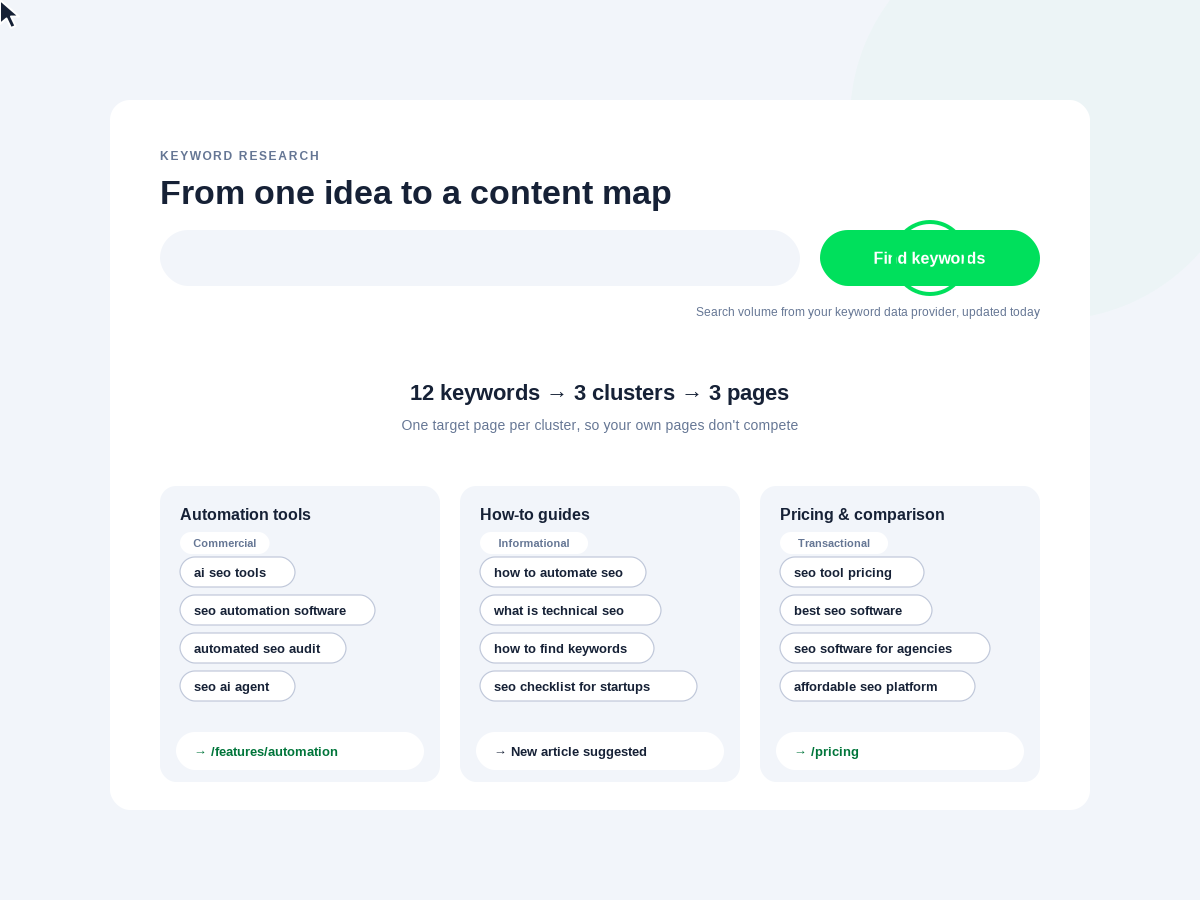
From one idea to a content map
Keyword ideas with provider data, AI topic clusters and a keyword-to-page map.
Guardrails
How we keep it safe and honest
- We never invent search volumes or ranking positions.
- Every number is labelled as measured or estimated, with when it was fetched.
- Provider metrics and AI estimates are displayed separately.
FAQ
Common questions
Where does search volume come from?
From an established keyword data provider. Providers estimate volume differently, so every number is labelled as an estimate with the date it was fetched.
How fresh is the data?
Each number shows when it was fetched. Keyword results are cached for 7 days, so repeating the same search within a week reuses the stored data instead of fetching it again.
How many keywords can I track?
Up to 50 starred keywords per website, within your plan's monthly rank-check limit.
How often are rankings checked?
Daily, weekly or monthly per keyword, on desktop or mobile, in Google's live results. You can also check rankings on demand.
Can I see the searches I already rank for?
Yes. Connect Google Search Console and Sonnetpilot shows the queries you already appear for, with clicks, impressions and average position measured by Google.
Does AI make up any keyword numbers?
No. Volume, cost per click and difficulty come from the data provider. AI is only used to group keywords into topics and label intent, and those labels are marked as AI-generated.
Can I find keywords my competitors rank for?
Yes. A keyword gap lists keywords a competitor ranks for in Google's top 20 where you aren't in the top 100, with volume and difficulty, and you can save the best ones to your list.
Further reading
Guides on this topic
- SEO for SaaS and startups: a practical playbookA step-by-step SEO playbook for SaaS companies and startups with a small team: which pages to build first, which keywords to target, and how AEO and GEO fit in.
- How to rank higher on Google: 10 steps that work for small sitesHow to rank higher on Google in 2026, in ten practical steps for small sites: fix indexing, match search intent, improve titles, answer questions, earn links and measure in Search Console.
- How to track keyword rankings on Google: free and paid waysHow to track your keyword rankings on Google: free ways with Search Console, when you need a rank tracker, how often to check, and how to read a keyword ranking report.
- How to analyze Google Search Console data with an AI assistantHow to analyze your Google Search Console data with an AI assistant: three ways to give it the data, the questions worth asking, a 15-minute weekly routine, and the mistakes that lead to wrong conclusions.
- Sonnetpilot vs Semrush: which one fits a small website?An honest comparison of Sonnetpilot and Semrush for small business sites: prices checked on 24 November 2026, what each tool does well, where Semrush is stronger, and how to decide.

Bring your website. We'll show you what to fix first.
Type your website and a free audit of up to 25 pages starts right after you sign up. No credit card required.